
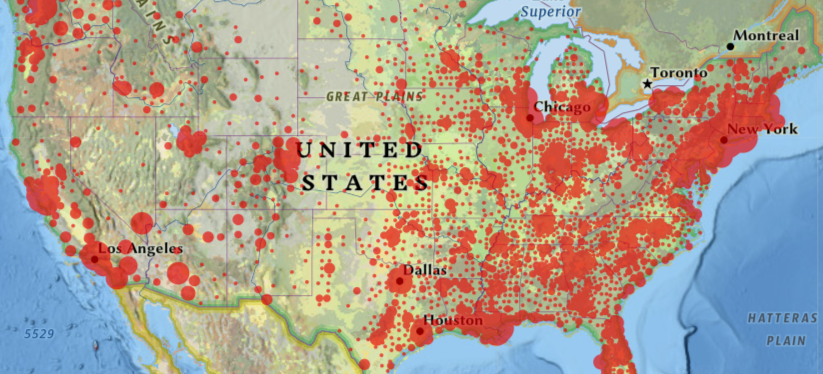
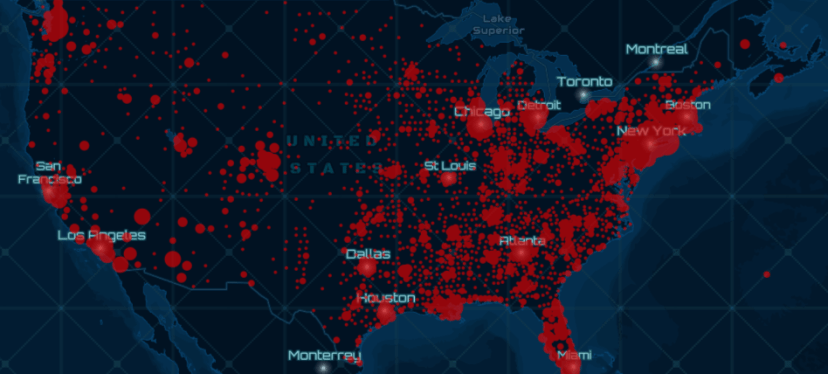
In the past few weeks, I’ve been tracking COVID-19 prevalence among U.S. largest cities. Now I want to turn my analysis to a smaller scale at the county level, to see the “hot spots” beyond metropolitan areas like New York, Boston, Detroit, and Chicago. Luckily both Gray Television and The New York Times have already complied and analyzed county-by-county COVID-19 data and have kindly made them open source.
Below shows the highest rate of COVID-19 among U.S. counties with more than 5,000 in population. I have changed the denominator from per 100,000 to per cent. In these worst-hit counties, COVID-19 infection rate (that we managed to test) has risen so high that we can measure in percentages—not per 1,000, not per 100,000. Besides, some of these smaller counties have population way less than 100,000.
COVID-19 Rate Highest In These Counties (Across The Country)
Updated: May 3, 2020 @ 12 a.m. EST
This table above surprises me because a lot of small, rural counties have COVID-19 rate that is higher or on par with big cities. Key takeaway: Don’t think for a second that COVID-19 is just a big-city problem. Outbreaks have and will explode in sparsely populated small towns just the same. And when it does, it can overwhelm the town’s medical and social-service infrastructure.
For the next level of analysis, I separate big counties (more than 50,000 people) from small counties (fewer than 50,000 people). See below.
COVID-19 Rate – Big County (More Than 50,000 People)
Updated: May 3, 2020 @ 12 a.m. EST
New York City And Surrounding Counties
The City of New York is actually not the highest-concentration counties in the NY Metro Area with COVID-19 infections. The highest are two counties just north of the city: Rockland and Westchester. Within the city limit, the Bronx and Staten Island have the highest COVID-19 rate among the 5 boroughs/counties that comprise New York City.
Prisons Are Hotbeds Of Infection
Marion and Pickaway Counties in Ohio – Most of the COVID-19 cases are from outbreaks in local prisons. Ohio’s governor has rolled out mass testing in the state’s prison system and reported a staggering 70% of inmates being positive for COVID-19. States with larger prison populations than Ohio have not done mass testing; thus, it’s likely that they have vastly underestimated COVID-19 prevalence among prison inmates and staff.
COVID-19 Rate – Small County (Fewer Than 50,000 People)
Updated: May 3, 2020 @ 12 a.m. EST
Prisons, Again…
Tennessee and Arkansas are discovering rampant COVID-19 infection inside their prisons as a result of widespread testing for inmates and staff. The results are frightening and shooting up the infection rate for a number of small, rural counties in which the prisons are located, like Trousdale and Bledsoe Counties in Tennessee and Lincoln County in Arkansas.
Meatpackers Have A COVID Problem
Meatpacking plants have caused huge spikes in COVID-19 infection rate in a number of small counties in the Midwest—leading to infection rate so high it rivals New York and New Jersey. Dakota County, Nebraska; Cass County, Indiana; Louisa County, Iowa suffer outbreaks in their Tyson Foods plants. Nobles County, Minnesota has an outbreak in a JBS plant. Southwest Kansas (which includes Ford and Seward Counties) is a beef-processing hub with large slaughterhouses run by National Beef and Cargill. JBS (Brazilian-owned), Tyson Foods, and Cargill are respectively the #1, #2 and #3 largest meatpackers in the world.
First Reported Outbreak in Rural America
Randolph County in southwest Georgia is part of the cluster of rural counties surrounding Albany that are heavily impacted by COVID-19 since the beginning of the epidemic. The outbreak reportedly stemmed from two funerals in late February and early March.
It’s Time For Solidarity
COVID-19 is NOT just a big-city problem; it’s not just an urban problem; it’s certainly not just a “Blue State” problem. It is all of America’s problem. As this analysis shows, COVID-19 is ravishing small towns in rural areas in “Red States” like Arkansas, Tennessee, Georgia.
Big cities, small towns, we are all in this together. It this is not time for solidarity; I don’t know when is. Communities large and small suffer and cope in different ways. In our different ways, I hope we choose the right path for our community to survive this epidemic and recover stronger.
Data Source:





 Ian Au Marketing Works