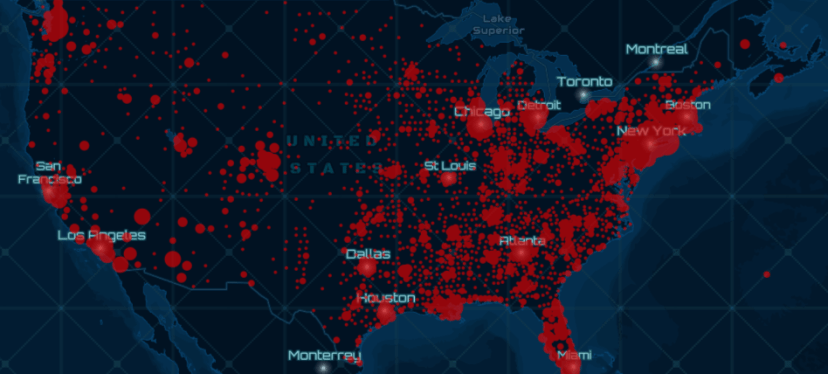
Confirmed Cases Per 100,000 People in Largest U.S. Cities
Updated: May 3, 2020 @ 12 a.m. EST
Like a lot of people, I have been scrutinizing COVID-19 statistics obsessively. Among U.S. states, we know that New York, New Jersey, and California have the most confirmed cases. But the sheer numbers of cases tell only part of the coronavirus story because states are vastly different in population: California (40 million) is about twice as big as NY State (19 million), which is about twice as big as New Jersey (9 million).
Numbers of cases alone don’t tell us how widespread COVID-19 is in a population: What’s the percentage of people that are infected? For that, a metric that’s useful is prevalence—the proportion (or percentage) of people in a given geographic area that are COVID-19 positive.
Now, I know from experts that the number of confirmed cases most likely under-represent the true picture of COVID-19 infection in America. Given the shortage, inaccessibility, and inconsistency in testing, the vast majority of the country is under-tested to a varying degree and only the most symptomatic of people are tested and counted. Still, confirmed cases and deaths are the only universally available and reliable metrics we have to measure the prevalence of coronavirus.
As a long-time resident of New York City now under stay-at-home order, I am particular motivated to understand the prevalence of COVID-19 in New York; and how bad it is compared to other U.S. cities. So I set out to map and track COVID-19 prevalence (proportion of people that are tested positive) among the largest and most affected cities in America.
I use a city metro area definition instead of strictly the city limit. The common standard of defining metro areas is the U.S. Census Metropolitan Statistical Area. Data of COVID-19 confirmed cases come from the now-famous Johns Hopkins University COVID-19 Tracker. COVID-19 prevalence is denominated as case per 100,000 people. So for example, as of Mar. 29, U.S.A. has 43 confirmed cases per 100,000 people; Italy has 162 per 100,000.
After crunching the numbers for the largest and most-affected U.S. cities. New York Metro Area is, not surprising, at the unfortunate top of the most-prevalent list. (NY Metro includes NYC’s northern suburbs, all of Long Island, and Northern New Jersey.) What’s worrying is the next most-prevalent city: Metro New Orleans, with a comparatively small population of 1.3 million and fewer resources. The other most-affected cities are Seattle, Detroit, Boston, Chicago Metro Areas.
I am not an epidemiologist or a demographer. Just an out-of-work marketing director who is trained in market research. My motivation is my immense fascination and grave concern with COVID-19 data and statistics and too much time on my hand while I’m grounded at home. I intend to update, track, and publish this “Mapping COVID-19 “Prevalence” in U.S. Cities” analysis on a daily (or near daily) basis because I am anxious to see how the numbers move. If you have advice on how to improve this, I’d love to hear it.
Data Source:

 Ian Au Marketing Works